Eleanor Roosevelt: Lake Placid Olympic Bobsledder
We’re going out on a limb here, but Eleanor Roosevelt may be the only First Lady to take a ride down an Olympic bobsled run—at speed.

In February 1932, Lake Placid hosted the III Olympic Winter Games in the heart of the Adirondack Mountains. Franklin D. Roosevelt, then Governor of New York, officially opened the Games.
By his side stood Eleanor Roosevelt—already a formidable public figure in her own right—who would soon add an unexpected Adirondack adventure to her long list of “firsts.”
Today, nearly a century later, the story of Eleanor Roosevelt’s bobsled ride remains one of the most colorful and enduring legends of the 1932 Winter Olympics in Lake Placid.
Lake Placid And The 1932 Winter Olympics.
Lake Placid earned the honor of hosting the 1932 Winter Olympics thanks to the vision of local leader Dr. Godfrey Dewey, son of Melvil Dewey, founder of the Lake Placid Club. Despite the Great Depression gripping the nation, organizers pressed forward, determined to stage a world-class event in the Adirondacks.
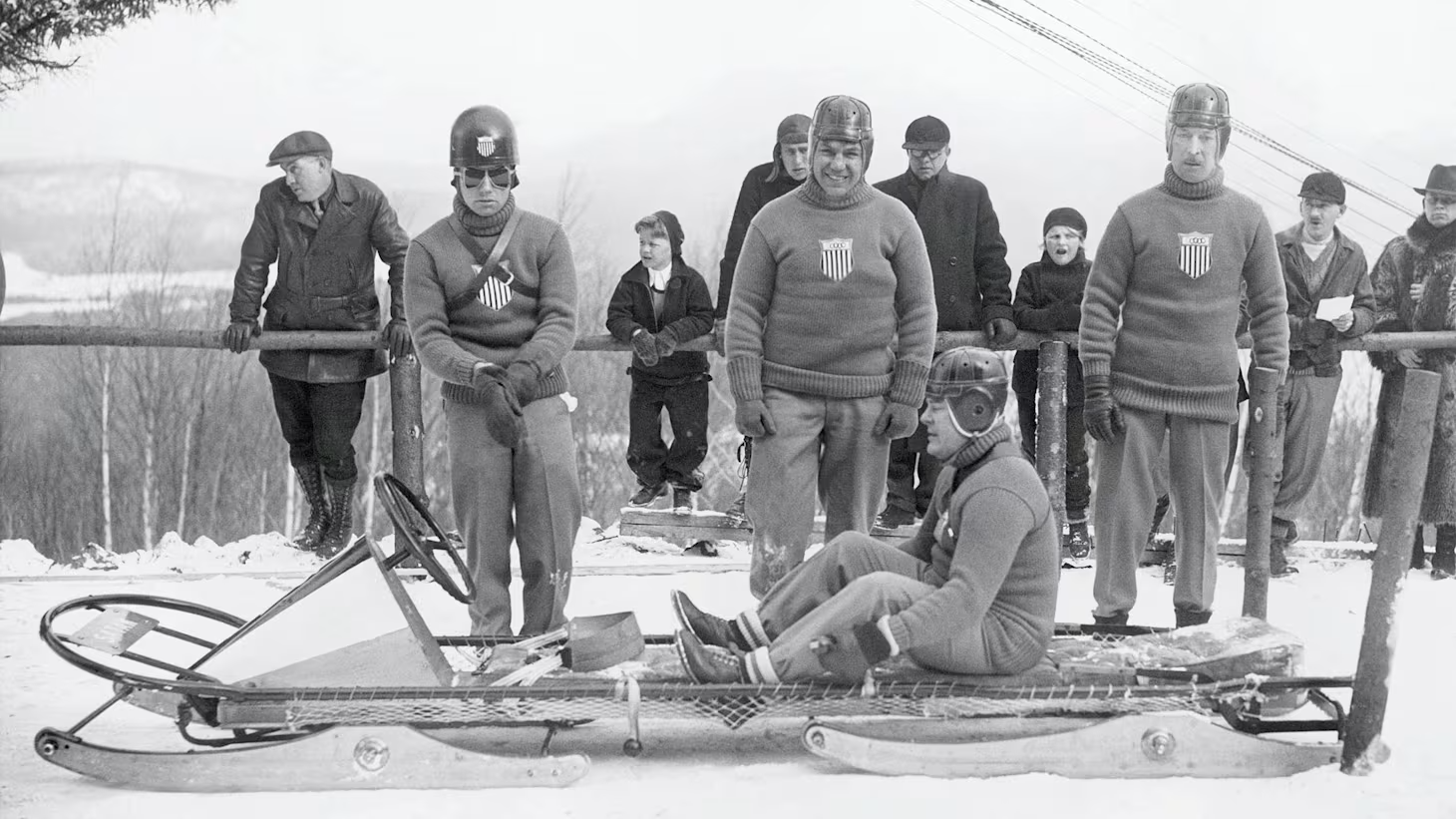
Four-man bobsled, 1932. Photo courtesy IOC.
The Games featured 252 athletes from 17 nations competing in figure skating, speed skating, ski jumping, cross-country skiing, ice hockey, and bobsledding. The newly constructed bobsled run at Mt. Van Hoevenberg stood as one of the most advanced sliding tracks in the world—fast, technical, and intimidating.
Franklin D. Roosevelt delivered the opening address on February 4, 1932. As Governor, he championed the Games as both a morale boost for the country and an economic catalyst for upstate New York. Eleanor Roosevelt embraced the moment with characteristic curiosity and fearlessness.
She did not simply observe history. She jumped into it.
The First Lady takes the run.
After attending Olympic events and a luncheon near the brand-new bobsled facilities, Eleanor Roosevelt expressed interest in seeing the track up close. One thing led to another. Soon, she agreed to take a ride.

It’s legit:: Mrs. Roosevelt’s Bobsleigh Waiver
According to The New York Times, the sled “passed through the ‘zigzag,’ a double series of curves, and a few moments later was visible streaking down the mountainside into the final curve. It shot up the wall of ice and down again and then raced under the finish bridge and up the slope to a standstill.”
Henry Homburger—often spelled Homberger in contemporary accounts—piloted the sled. A member of the 1932 U.S. Olympic bobsled team, Homburger ranked among America’s top drivers. He guided Mrs. Roosevelt down the twisting ice chute at speeds estimated to exceed 60 miles per hour.
Afterward, the Associated Press reported that Mrs. Roosevelt “complimented Homberger on his skill in handling the sled,” and Homburger praised her courage.
Photographs from the day show her wearing a leather helmet and bundled against the Adirondack cold. The image feels cinematic: America’s future First Lady hurtling down a sheet of Adirondack ice during one of the most challenging moments in American economic history.
To date, historians have found no evidence that any other U.S. First Lady has ridden an Olympic bobsled track with a national team. That detail adds yet another “first” to Eleanor Roosevelt’s remarkable résumé.
The 1932 U.S. Bobsled Team And Adirondack Innovation.
The U.S. bobsled team in 1932 delivered a strong performance on home ice. The four-man team, led by Eddie Eagan—who had already won a gold medal in boxing at the 1920 Summer Olympics—captured gold in Lake Placid. Eagan remains the only athlete in Olympic history to win gold medals in both the Summer and Winter Games in different sports.
The two-man team also earned medals, cementing Lake Placid’s reputation as a serious sliding venue.
The Mt. Van Hoevenberg run itself represented a technological leap. Engineers carved the track into the mountainside using Adirondack labor and ingenuity. Workers shaped the curves by hand, packed ice, and maintained the run in unforgiving winter conditions. The track became a source of local pride and positioned Lake Placid as a permanent fixture in international winter sport.
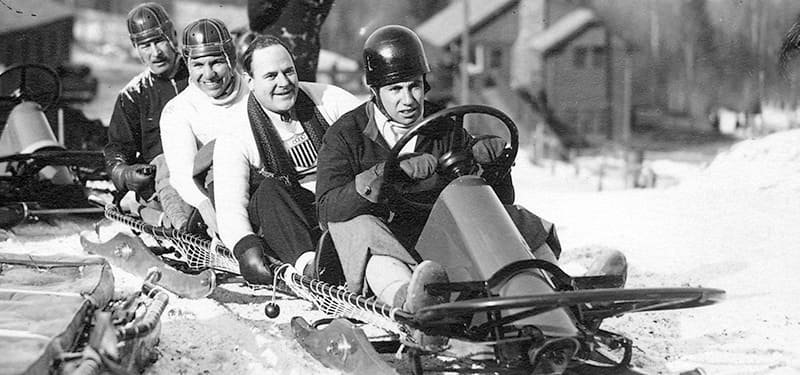
US 1932 Olympic Bobsled team. Photograph: Courtesy of 1932 & 1980 Lake Placid Winter Olympic Museum.
Bobsledding had evolved rapidly since its origins in the 1880s in both upstate New York lumber towns and Swiss Alpine resorts.
The first organized competition took place in 1898 on the Cresta Run in St. Moritz. By 1923, the Fédération Internationale de Bobsleigh et de Tobogganing formalized the sport, and the 1924 Winter Games in Chamonix included bobsled competition.
By 1932, Lake Placid stood at the forefront of that evolution.
Check out this article from The Guardian, entitled “The Forgotten Story of Those Magnificent Men and Their Flying Bobsled.” It’s a great read.
Eleanor Roosevelt’s Adirondack Spirit.
Eleanor Roosevelt’s bobsled ride did more than generate headlines. It reflected her personality.
She consistently challenged expectations of what a First Lady could do. She traveled widely, held press conferences, advocated for civil rights, and later played a key role in drafting the Universal Declaration of Human Rights as a U.N. delegate.
Her decision to ride the bobsled demonstrated confidence and modernity at a time when women—especially public figures—faced strict social constraints. She embraced the Adirondack setting not as a passive spectator but as an active participant.
Lake Placid, in turn, gained an unforgettable story.
Lake Placid’s Enduring Olympic Legacy.
Lake Placid remains one of only a handful of cities worldwide to host two Winter Olympic Games: 1932 and 1980.
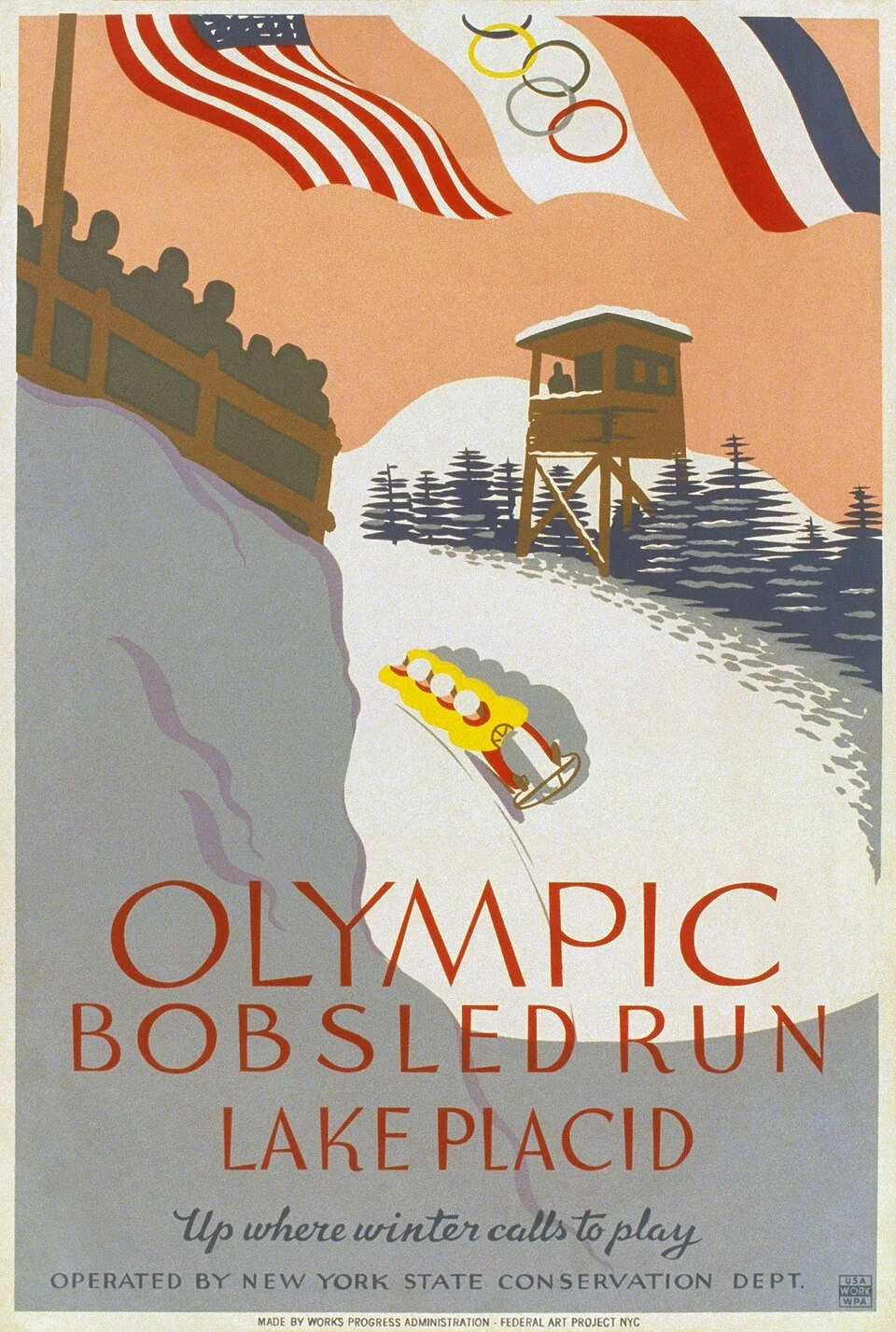
The 1980 Games delivered the “Miracle on Ice,” when the U.S. men’s hockey team defeated the Soviet Union. That victory further elevated Lake Placid’s place in Olympic lore. Yet the foundation for that legacy began in 1932, with the construction of world-class venues and bold moments as Eleanor Roosevelt’s run down the ice.
Today, Mt. Van Hoevenberg operates as a premier sliding sports complex. Visitors can watch World Cup bobsled, skeleton, and luge competitions—or book a passenger bobsled experience and feel the G-forces themselves. The Olympic Jumping Complex and Olympic Center in Lake Placid continue to host training camps, events, and public skating.
For travelers searching for the best winter events in the Adirondacks, Lake Placid delivers more than nostalgia. It offers living history.
Planning Your Olympic-Inspired Adirondack Visit.
Visitors exploring Lake Placid can:
Tour the Lake Placid Olympic Museum at the Olympic Center
Drive or ski Mt. Van Hoevenberg’s trail system
Book a passenger bobsled experience
Attend World Cup sliding events
Walk Main Street and soak in the mountain views that framed both Olympic Games
Winter in the Adirondacks still carries the electric energy that Roosevelt and thousands of spectators felt in 1932. Snow sparkles on Mirror Lake. Flags snap in the wind. And the bobsled track still hums with speed.
Eleanor Roosevelt’s ride reminds visitors that the Adirondacks do not simply host history. They invite participation.
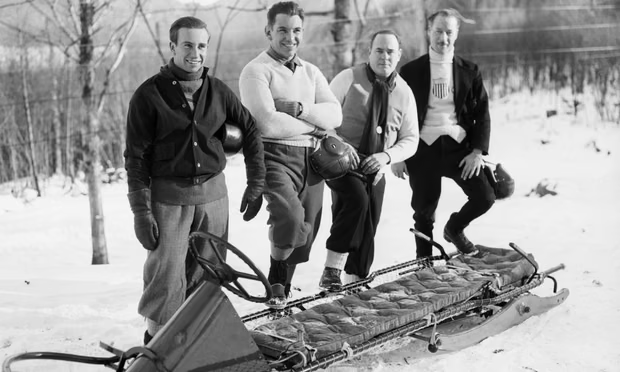
From left: Billy Fiske, Eddie Eagan, Clifford Gray and Jay O’Brien, at Lake Placid in 1932. Photograph: Bettmann/Corbis
Why This Story Still Matters.
Search for “Eleanor Roosevelt Lake Placid,” “1932 Winter Olympics Adirondacks,” or “Lake Placid bobsled history,” and you’ll uncover a treasure trove of Olympic lore. Yet few stories capture the imagination quite like that leather-helmeted First Lady rocketing down an icy Adirondack track.
For those planning a winter trip—or simply exploring Lake Placid’s Olympic legacy—this moment offers a vivid entry point into a deeper story: innovation, courage, and the enduring spirit of the Adirondacks.
Nearly 100 years later, the ice still runs fast.